

SOUND UNIVERSE las voces de ellas Elements that compose it
Voices
Strings
Design
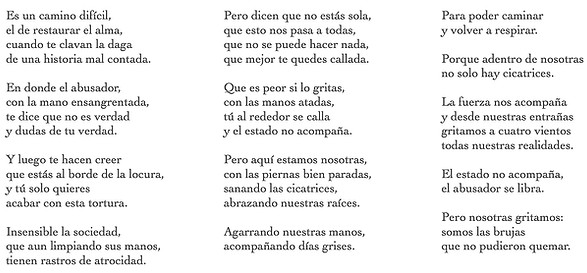
The poem is structured as a chronological journey through abuse and its effects, where the voice traverses different emotional and generational stages. The narrative begins with the wound and confusion—"it's a difficult path"—exposing the abuser's manipulation and the internal fracture left by the violence. Later, a second voice appears: "but they say you're not alone," revealing the contradictions of a society that pretends to offer support while simultaneously silencing and revictimizing.
In the final part, a collective affirmation emerges —“we are the witches they couldn’t burn”— that transforms the story into an act of resistance, memory, and recovery of the voice, taking the poem from vulnerability to collective empowerment.
It is composed of a string arrangement, which gives a melancholic tint, however it is planned to distort them in the mix, several keyboards, which intend to give a confusing atmosphere given the concept and also give a harmonic base, there is an organ at the end where its purpose is the sound of death, acoustic piano, of melancholy and harmonic base, drums, which are linked with the heartbeat that give a base with a lot of force and punch like daggers vocal arrangement that intends to be a harmonic cushion and give movement to the main voice.
The sound design was built around the feelings that accompany the emotional development of the song, primarily using the heart and the sea as narrative elements. The heartbeat begins agitated and, as the melody and lyrics progress, begins to slow down, reflecting the emotional journey of the voice within the composition. Similarly, the sea initially appears calm and gradually transforms until it becomes more intense and turbulent at the narrative's most powerful point.
The sound design accompanies and amplifies the development of the instruments, reinforcing the tension and emotional impact of the piece. Towards the end, the track concludes once again with the sea and the heart, but this time with a faster heartbeat, a more aggressive sea, and a delayed-processed vocal note that serves as a transition and introduction to the next track on the EP.

Artists
ALYOSHA - Singer
Alexandra Rondon Daza - Voice
Nubia Daza Paredes - Voice
Maria Paula Casas - Cellist
Maria Camila Muñoz - Violinist
Daniela Ardila - Violinist
Valentina Camacho - Violist
Research topics
Memory
Trauma
Female voices
Emotional narratives
Sound identity
Collective healing
Creative Responsibilities
Narrative development
Storytelling
Development of sound identity
Interdisciplinary artistic research
Conceptual development
Creative direction
Original musical composition
Vocal direction and production
Sound design
Recording
Mix
Audiovisual conceptualization